
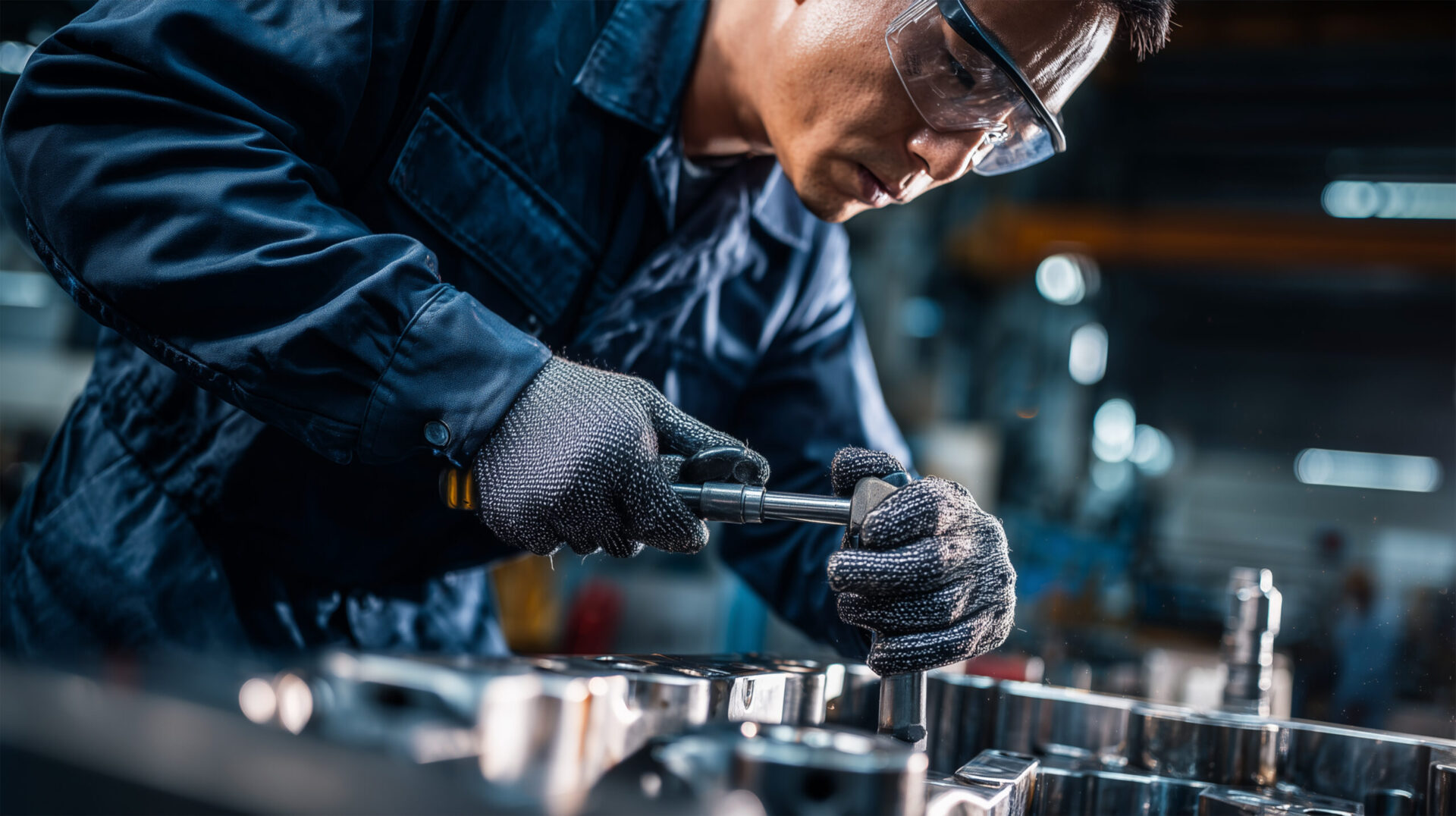
Ota City, Tokyo — long celebrated as a hub of Japanese manufacturing — the number of industrial establishments now stands at just 3,584.
The number of factories in Ota peaked at 9,190 in 1983 and has been declining ever since.
There was a time when factories dotted the streets of the neighborhood — small and mid-sized manufacturers supporting machining, sheet metal, and mold-making at every turn. That world has shrunk considerably.
The reasons trace back to shifts in industrial structure.
Facing intensifying cost competition, large corporations moved their production overseas and began sourcing cheaper components from abroad. Work for domestic subcontractors, sub-subcontractors, and the small factories further down the chain gradually dried up.
It would be hard to say those decisions were simply wrong at the time, given the business logic of the era.
But the bill is coming due.
Expertise that should have been preserved domestically is fading. The people who could read a blueprint, listen to a machine, feel the grain of metal, and sense an anomaly from a faint vibration — there are fewer of them now. Young people to carry that knowledge forward are in short supply too.
And yet, I have not given up on Japanese manufacturing — on the companies that are still standing.
Because the world is turning back toward the physical.
Table of Contents
1. The Keyword Is Physical AI
One of the most talked-about concepts right now is “Physical AI.”
Physical AI refers to the integration of artificial intelligence into machines and systems that operate in the real world — robots, manufacturing equipment, defense hardware — enabling them to make judgments and perform control functions autonomously.
This shift is already showing up as renewed expectations for Japanese companies.
A June 3, 2026 article in the Nikkei Shimbun, headlined “Physical AI stocks are surging — outpacing even Nvidia,” reported growing investor interest in companies tied to the Physical AI space. Attention is focusing on the ecosystem of firms that AI needs to function in the real world — robots, sensors, control systems, and logistics equipment — with Fanuc and Murata Manufacturing cited as examples.
Somewhat adjacent to Physical AI in the narrow sense, Hitachi has been working on AI that automatically detects and corrects faults on production lines — diagnosing problems and rewriting programs on its own. The company positions this as a way to compensate for the shortage of skilled workers on the factory floor.
Global companies — Nvidia, Foxconn, Xiaomi, Siemens — are pushing AI into manufacturing as well. This is not a Japan-only story. The world’s manufacturers are working to embed AI into real production environments.
2. Defense, Energy, and Robotics Are All Looking Back at Japanese Manufacturing
The domains where Physical AI matters extend well beyond the factory floor.
Mitsubishi Heavy Industries has been moving to develop domestically-produced AI technology for integration into defense equipment. The company is said to be partnering with domestic AI startups to advance the development of AI for defense systems and platforms.
What makes this significant is that AI is no longer just a tool for operational efficiency — it is becoming central to national security and defense capability.
Defense hardware, aerospace, energy, critical infrastructure — in these fields, excellent AI alone is not enough. An aircraft body, sensors, components, communications, control systems, and safety mechanisms all have to come together for the system to work.
What this demands is the full depth of manufacturing capability.
China is currently at the frontier of Physical AI globally. In terms of production volume and speed, China is a formidable presence.
But when national security risks are factored in, concern is growing across countries about whether it is wise to depend on China for all manufacturing.
That is where Japanese manufacturing comes in.
Japan has a depth of industrial infrastructure supporting Physical AI — robotics, precision machining, advanced materials.
And at the foundation of that depth, I believe, are small and mid-sized manufacturers.
This is not to say that the small factories of Ota City will transform overnight into Physical AI development companies.
AI model development will primarily be the domain of large corporations, startups, and research institutions.
But for AI to function in the real world, you need parts, jigs, enclosures, sensor mounting, prototyping, iteration, and on-site implementation. That is precisely the territory of small and mid-sized manufacturers.
If Physical AI brings renewed attention to small factories, it will not be as “companies that build AI” — it will be as the physical backbone that makes AI move in the real world.
3. Can Software Alone Support Human Life?
Japan has fallen significantly behind the US and China in software and AI. There is no looking away from that reality.
The first half of the twenty-first century has clearly been driven by software. Search, cloud, SaaS, smartphones, generative AI. Enormous wealth has concentrated in software companies.
But I want to pause and think for a moment.
People move.
People eat.
People live in spaces that need to be comfortable.
People need care as they age.
Can software alone sustain all of this?
Software is necessary. AI is necessary. Data is necessary. But none of it changes how people actually live until it connects with the physical world.
In the shadow of software’s enormous economic rewards, have we undervalued hardware? Have we been too quick to write off the ability to make things as an old industry?
4. SaaS May Be Faltering, but Demand for Hardware Never Goes Away
People have even started talking about “the death of SaaS.”
That is not to say SaaS will vanish entirely. But in the software world, today’s advantage is no guarantee of tomorrow’s. The speed at which technology shifts can swallow a market is extraordinary.
Demand for hardware, by contrast, does not disappear. When physical infrastructure stops, life stops.
What is it, in the end, that human beings cannot live without?
That is why the value of manufacturing — the industries that hold up the physical world — will not fade no matter how far digitization advances. If anything, the further AI progresses, the more important the capacity to make AI work in physical reality becomes.
5. Three Laps Around — and Manufacturing Comes Out on Top
The first lap was the age of making things.
Good products sold. Japanese manufacturing swept the world on the strength of quality and shop-floor capability.
The second lap was the age of software.
The internet, smartphones, cloud, SaaS, AI. The center of value shifted from hardware to software. Japan missed that wave.
And now, the third lap is here.
An era in which AI enters the physical world.
An era in which software and hardware come back together.
An era in which data and the shop floor, algorithms and machining, AI and robotics become one.
What the third lap requires is not software alone, and not hardware alone. It requires the ability to connect both.
6. Japanese Manufacturing Raised Me
My father was an engineer at Mitsubishi Heavy Industries.
He was one of many hands that supported Japan’s high-growth era. His name will not appear in the history books of any great industry. But he was someone who supported the technology, the equipment, and the craft of making things — on the ground, every day.
My own first job out of university was at Hitachi.
I was involved in negotiations with American companies, working to increase the value of the semiconductors Hitachi was producing at the time.
Looking back, I realize that Japanese manufacturing has shaped who I am from the very beginning.
Today, I support small and mid-sized manufacturers in building market presence and developing their marketing.
Companies with remarkable technology, but no real conversation with a wider market.
Companies playing a critical role behind the scenes for major corporations, but unable to articulate their own value.
Every time I encounter one of those companies, I feel it again — Japanese small and mid-sized manufacturing still has enormous potential.
7. For Japanese Manufacturing to Be Needed by the World Again
For Japanese manufacturing to come out on top after three laps, nostalgia alone — “we used to be great” — is not enough.
What is needed is to protect the craft on the shop floor.
To pass it on to the next generation.
To use AI and data as tools, not treat them as threats.
And to clearly communicate what each company is genuinely good at.
The skills of a small factory will not be discovered if no one speaks up about them.
If Japanese manufacturing is to be genuinely revalued in the age of Physical AI, the starting point will always be communication with the market.
I am someone who was raised by Japanese manufacturing. I want to remain one of the many nameless hands supporting its future.

Contact Us
We offer a free initial consultation.
If you are considering marketing strategy or subsidy utilization,
please feel free to reach out.